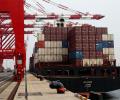
The Major Ports Authority Bill, 2020 was passed through ballot votes in the Rajya Sabha on Wednesday with 84 votes in its favour and 44 against it. The Lok Sabha had passed the bill on September 23 last year.

The road network will stretch from Gujarat to Mizoram.

India and Iran on Monday decided to jointly combat terror, radicalism and cyber crime as the two strategic partners signed 12 agreements including a "milestone" pact on developing the key Chabahar port for which India will provide $500 million.
'If there is one certainty in this visit, it is that Trump does not follow a script. He is unpredictable,' highlights Ambassador B S Prakash.
'The world does not care about the tension on our border.' 'India has to emerge as a strong economic power.' 'Respect comes when the world sees a country with a direction and leadership that has a vision,' points out Ramesh Menon.

'With the recent challenging of the notion of the Indian Ocean Region being India's strategic backyard, China is gradually upping the ante in the maritime realm around India.'
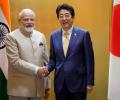
With the signing of the pact, the Quad grouping of India, Japan, Australia and the US is set to gain more heft now, notes Dr Rajaram Panda.
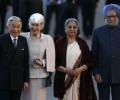
In recent years India-Japan relations have acquired rich economic content and strategic intents. Although the bilateral trade at $18 billion between the two countries is not very impressive and leaves much to be desired, the economic engagement between the two countries is both qualitatively and quantitatively noteworthy. India-Japan defence cooperation, however, has generated a lot interest among the strategic community in the context of rise of China. There has been a lot of speculation about India-Japan strategic partnership to hedge China, says Rup Narayan Das.

'China's moves are of direct significance to India, which will closely monitor Chinese naval activity in the Bay of Bengal and the Indian Ocean not least because of Chinese maps depicting claims over the Andaman and Nicobar Islands.'

PM Modi seems to be gradually ending India's strategic ambiguity

Modi, in an op-ed published in the Wall Street Journal, wrote that the US and India are forging a deeper and stronger partnership that extends far beyond the Beltway and the Raisina Hill.
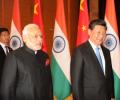
While the two sides' objectives may appear to differ, it is clear that both India and China are emphasising on the common minimum possible areas of cooperation between them, says Srikanth Kondapalli.

India and the United Kingdom on Thursday announced deals worth 9 billion Pound (Rs 90,550 crore) as they signed a civilian nuclear pact and decided to collaborate in the field of defence and cyber security besides launching a railway rupee bond in London.

Four major political takeaways from Narendra Modi's much-anticipated trip to China
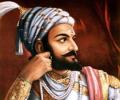
'Shivaji was among a handful of Indian rulers to realise the importance of sea power... Not much attention is paid to his remarkable achievement: Building a modern navy and the revival of Indian maritime power.'
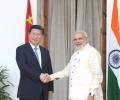
With the continuing stand-off in Ladakh casting a shadow over the Sino-India talks, Prime Minister Narendra Modi on Thursday raised 'serious concerns' over the repeated incidents along the border and sought an early settlement of the boundary question.
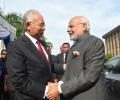
Both countries will advance maritime security and strengthen disaster response in the region, says Modi.
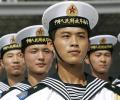
Right from conducting nuclear deterrence patrols in 2015 to its destructive space programme, from its back-tracking on economic commitments to its hardened positions on Sino-India border deal -- its approach with India spells Adversarial with a capital A, says Shehzad Poonawalla

'India-US defence pacts are seen by many analysts as a subtle move to jointly contain China's growing militarism, especially in the strategic Indian Ocean Region.'

The President said Indian economy grew at 5.7 per cent during the first quarter of 2014-15.

'Xi Jinping got a dose of Modi's medicine inside the tent where he was being hosted on the banks of the Sabarmati river.' 'Modi reportedly told him, looking deep into his eyes: "This was not expected of your country. Can you tell me when the troops are withdrawing?".'

'Chinese leaders rarely receive their foreign guests in cities other than Beijing. Such respect for India!' 'Does it mean that Modi could replicate "the warmth and unconventional way" by sending Indian troops into Tibet, as Xi did in Chumur (Ladakh) when he arrived in India? Of course, Indians are far too polite to do so,' says Claude Arpi.

As India rises, creating niche areas for itself in the Asian landscape, China and India are bound to step on each other's vital areas of importance, says Srikanth Kondapalli.

'Implementation of the US-India Defence Technology and Trade Initiative is as much a test for the Modi government to direct its bureaucratic processes, as it is of US commitment,' says Lieutenant General Anil Chait (retd).

'The intrusion in Chumar, during and beyond the Chinese president's visit, is unprecedented and has qualitatively changed the tone of the India-China relationship,' says Jayadeva Ranade, a member of the National Security Advisory Board.
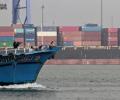
Modi government expects cargo traffic at its ports to jump by two-thirds by 2021 as India ramps up exports of goods including cars and other machinery.

'No matter how severe sanctions the UN security council imposes on North Korea, the impact of the sanctions would depend on how faithfully they are enforced by China,' says Dr Rajaram Panda.

'Both Modi and Xi know that if all that there is to show for Modi's visit -- barely eight months after Xi's India trip -- is a repeat of the same old declarations, there will be a terrible sense of letdown in the public mood resulting in future summits losing credibility. Only the possibility of new ground being broken can justify Modi's trip at this time,' says B S Raghavan.

Once again an Indian prime minister has realised that with Pakistan and China, things will not move as he wishes.

'The Modi-Xi and Modi-Obama meetings, with an interval of just 12 days, are juxtaposed superbly at a crucial point in the prime minister's life. Can Modi carve out a win-win situation with the superpower and the emerging superpower at the same time?'

Given our troubled relationship with Pakistan, we need to keep our security apparatus in a state of alert with state-of-the-art equipment. All bilateral issues with Pakistan -- political, military, economic -- will simply have to go on the back-burner till Pakistan decides it wants to live as a good neighbour, says Vikram Sood.
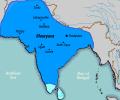
'There is a remarkable link between the eating of beef (or at the very least, tolerating the eating of beef) and India being a superpower.' 'In India, whenever an empire was strong, religion took a back seat.' 'Alternatively, whenever religion asserted itself, the main empire of India crumbled...'
'China made it evident that neither the swing-ride at Ahmedabad nor the red carpet at New Delhi worked, by timing its muscle-flexing in Ladakh to coincide with Xi's visit.'
'It is a pattern of behaviour of the Chinese that whenever a Chinese leader visits India or an Indian leader visits China, some incidents take place.' 'When Modi visits China, we should look out for some similar demonstration by the Chinese.'

Indian Prime Minister Narendra Modi who envisioned Make In India last September was at his eloquent best as he made a fervent plea to global businesses to come Make In India.

The developments in Af-Pak region, particularly the fall out of Pak political paralysis, would make President Xi Jinping's task a little more complicated, says Colonel R Hariharan.

A sensational interview on India-China ties, with the man most qualified to answer.

President Pranab Mukherjee on Monday addressed the first joint sitting of Parliament as mandatorily required under the Constitution after the general elections. The address is the political, economic and foreign policy road map of the Narendra Modi government and covers virtually all crucial areas.
